

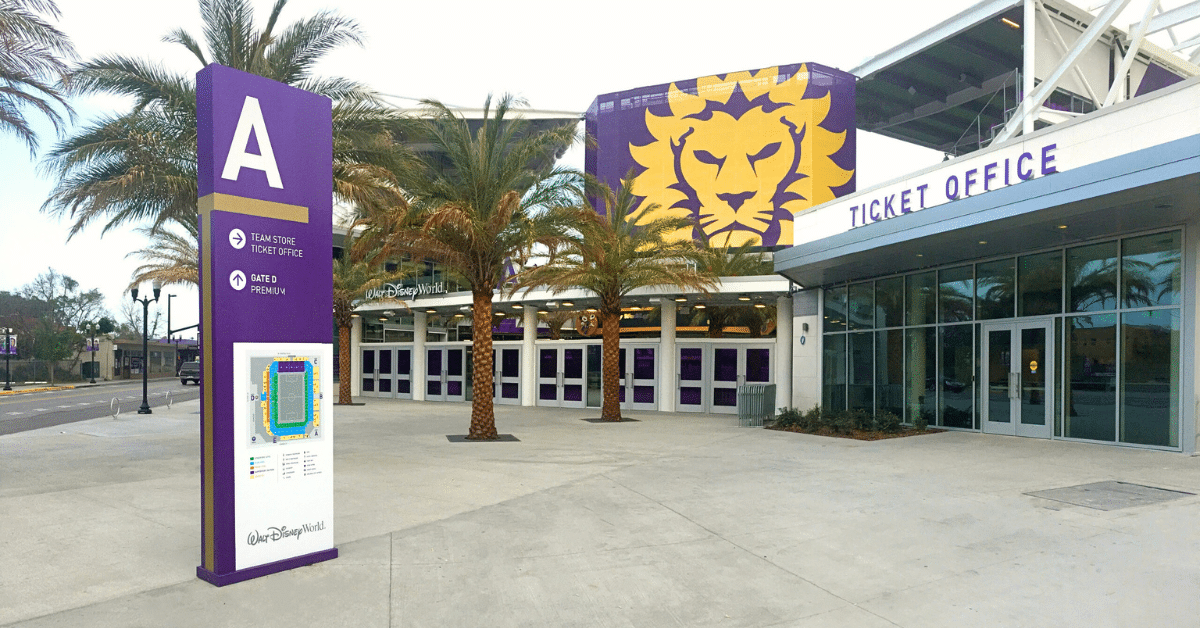
A sports stadium is much more than a place where fans gather to watch a game. It is a large, complex environment that may include parking areas, multiple entrances, concourses, seating sections, concessions, restrooms, premium areas, team spaces, and exits. Thousands of people may need to move through these spaces at the same time, often while visiting the venue for the first time. Clear signage plays an important role in making that experience feel organized and easy to navigate.
Effective sports stadium signage needs to accomplish several goals at once. It should help visitors understand where they are going, remain visible in crowded environments, complement the identity of the team or venue, withstand frequent use, and provide important information without overwhelming fans.
Because stadiums are larger and more complicated than most commercial properties, signage planning should begin with the entire visitor journey in mind. From the moment someone approaches the property until they leave after an event, signs can influence how easily they move through the venue.
1. Understand the Complete Fan Journey
Before deciding where individual signs should go, it helps to understand how visitors actually experience the stadium. A fan’s journey does not begin when they reach their seat. It may begin several blocks away as they approach the property by car, public transportation, rideshare, or on foot.
Once visitors reach the stadium, they may need to locate parking, determine which entrance to use, pass through security, find their seating section, locate concessions or restrooms, and eventually navigate back out of the venue. Each transition creates an opportunity for confusion if information is missing or difficult to find.
Planning sports stadium signage around this complete journey helps create a more connected system. Instead of viewing each sign as an individual element, venue planners can consider how one sign leads visitors toward the next piece of information they need.
For example, a parking sign may direct fans toward a specific entrance. Once they reach that entrance, another sign can identify the appropriate concourse. From there, directional signs can lead toward seating sections. This progression allows visitors to make smaller, easier navigation decisions instead of trying to understand the entire venue at once.
Thinking through the fan journey is especially valuable for first-time visitors, who do not have previous experience with the property to guide them.
2. Prioritize Visibility and Readability
Stadiums are visually busy environments. Fans may be surrounded by architecture, team graphics, advertisements, concession areas, crowds, and other visual information. Signage needs to remain easy to identify within that environment.
Sports stadium signage should be designed around realistic viewing conditions. Letter size, contrast, sign dimensions, mounting height, and placement can all influence whether information is noticed and understood quickly.
Viewing distance is particularly important. A sign intended to direct drivers toward parking needs to communicate from much farther away than a sign identifying a restroom inside a concourse. Likewise, signage positioned above a large crowd may need different proportions than information intended for someone standing directly in front of it.
Readability also means keeping information focused. Trying to communicate too many destinations on a single sign can make navigation more difficult rather than easier. Wherever possible, signs should provide the information visitors need at that particular decision point.
Designing for visibility from the beginning helps ensure signs are not only visually appealing but useful when thousands of people are moving through the venue.
3. Create an Effective Wayfinding System
Wayfinding is one of the most important functions of sports stadium signage. Large venues often contain multiple levels, gates, sections, corridors, and amenities. Even a visually impressive stadium can create a frustrating experience if visitors consistently struggle to find their destinations.
An effective wayfinding system should establish a clear hierarchy of information. Major destinations, such as gates, seating sections, and exits, should be easy to identify. Secondary destinations, including concessions, restrooms, guest services, and premium spaces, can then be incorporated into the system without competing with essential directional information.
Consistency is also important. If seating sections are identified using one naming convention near the entrance and another farther inside, visitors can quickly become confused. The same applies to arrows, icons, colors, and terminology.
Signs should also appear before visitors need to make a decision. Directional information placed after a hallway intersection or concourse split is significantly less useful than information positioned early enough for people to react.
Good wayfinding reduces unnecessary backtracking and helps distribute visitors more efficiently throughout the property. It can also reduce the number of basic directional questions staff members need to answer during busy events.
4. Account for Heavy Crowds and Traffic Flow
A stadium may function very differently when empty compared with game day. Signs that are perfectly visible during a walkthrough can become partially or completely blocked when thousands of fans fill concourses and entrance areas.
For this reason, sports stadium signage should be evaluated under expected crowd conditions. Overhead placement, larger formats, repeated directional information, and strategic positioning can help keep important signs visible when sightlines at eye level become obstructed.
Crowd flow should also influence what information appears where. Entrances need clear identification to help fans reach appropriate gates. Concourse signage should help distribute visitors toward different seating sections and amenities. Exit signage should support an orderly transition out of the stadium when large numbers of people leave at approximately the same time.
Bottlenecks deserve particular attention. If several pathways meet in one area, signage should provide information before fans reach the most congested point. This gives visitors time to choose the correct direction without stopping abruptly in a busy walkway.
Understanding traffic patterns allows signage to support the overall movement of the venue rather than simply identifying individual destinations.
5. Keep Branding Consistent Throughout the Stadium
A stadium is also a branded environment. Team colors, logos, typography, architectural features, and visual graphics contribute to the atmosphere fans associate with the venue.
Sports stadium signage can reinforce that identity while still remaining functional. Building identification, section markers, entrances, branded environmental elements, and other signage can carry recognizable visual details throughout the property.
Consistency matters because fans encounter signs repeatedly during a visit. When colors, typography, materials, shapes, and other design elements feel connected, the stadium becomes a more cohesive environment.
Branding should never come at the expense of readability, however. A decorative typeface may work well for a large team logo but be difficult to read on directional signage. Certain brand colors may also require additional contrast when used for navigation.
The most effective approach balances personality with function. Fans should recognize the character of the team or venue without having to work harder to understand important information.
This balance can be especially important when a stadium hosts multiple types of events. A strong foundational signage system can maintain the venue’s visual identity while allowing temporary event-specific elements to change as needed.
6. Select Materials for Durability and Long-Term Performance
Stadium signage can experience demanding conditions. Exterior signs are exposed to sunlight, rain, temperature changes, wind, and other environmental factors. Interior signage may experience heavy pedestrian traffic, frequent cleaning, accidental impacts, and continuous use during events.
Sports stadium signage should therefore be designed with durability in mind. Material selection should reflect where the sign will be installed, how visitors will interact with it, and the conditions it is expected to withstand.
Durability does not only affect structural performance. It also affects appearance. Faded graphics, damaged finishes, worn lettering, or deteriorating materials can make a venue look older and less maintained than it actually is.
Different areas of a stadium may require different material approaches. Exterior identification signage needs to perform in outdoor conditions, while interior directional systems may prioritize different qualities. High-contact areas may require finishes that are easier to maintain, while architectural signage may need materials that coordinate closely with the surrounding building.
Choosing appropriate materials during the planning stage can help signage maintain its appearance and function over a longer period of time.
7. Plan for Accessibility, Safety, and Future Changes
Accessibility and safety should be integrated into signage planning from the beginning. Stadiums welcome visitors with different abilities, ages, languages, and levels of familiarity with the property. A successful system should help as many people as possible navigate confidently.
Sports stadium signage may need to account for accessibility requirements involving elements such as contrast, tactile characters, braille, mounting locations, and identification of accessible routes or facilities where applicable. Specific requirements can vary depending on the sign and its location, making compliance an important part of professional planning.
Safety information also needs to remain clear and easy to locate. Emergency exits, restricted areas, evacuation routes, and other critical information should not become lost among decorative or promotional elements.
At the same time, stadium planners should think about the future. Venues change. Seating sections may be renovated, amenities may move, entrances may be reconfigured, and new spaces may be added.
A signage strategy that allows for future updates can help a venue adapt without creating a patchwork of mismatched signs. Modular components, consistent design standards, and documented signage guidelines can make later additions easier to integrate.
Planning beyond immediate needs can extend the usefulness of the overall system and help the stadium maintain consistency as it evolves.
Look at Signage as a Connected System
One of the most common problems in large venues is approaching signs individually rather than as part of a complete system. A new sign gets added whenever confusion occurs, but there may be little consideration for how it relates to existing signage.
Over time, this can result in repeated information, inconsistent terminology, conflicting directions, or signs that look completely different from one another.
A better approach is to evaluate sports stadium signage as a connected network. Every sign should have a specific role within the visitor journey. Major identification establishes destinations, directional signage helps people reach them, and smaller identification signs confirm that visitors have arrived.
This type of planning also makes it easier to identify gaps. If visitors consistently ask for directions in one location, the problem may not be that the stadium needs more signs everywhere. It may simply need better information at one critical decision point.
Consider Signage From a First-Time Visitor’s Perspective
Stadium staff members and regular attendees naturally become familiar with a venue. They know which parking lot is closest to a particular gate, which staircase reaches a certain section, and where different amenities are located.
First-time visitors do not have that knowledge.
Reviewing a signage system from their perspective can reveal issues that are easy for regular users to overlook. A useful exercise is to select several common destinations and attempt to reach them using only the information available on signs.
Can someone move from parking to the correct entrance without asking for help? Can they locate their seating section after entering? Are restrooms and concessions clearly identified? Can they easily determine how to leave the property?
These simple questions can reveal whether the existing system communicates enough information at the right moments.
Build Flexibility Into Multi-Use Stadiums
Many modern stadiums host far more than one type of sporting event. Concerts, festivals, community events, corporate gatherings, and other activities may bring audiences into the venue throughout the year.
A signage system should account for this flexibility where appropriate. Permanent signs can identify consistent destinations such as entrances, restrooms, elevators, and exits, while other areas may require information that can change based on the event.
This is another reason a strong underlying wayfinding structure matters. Even when the purpose of the event changes, visitors still need to understand the physical environment.
By establishing consistent navigation throughout the property, venues can accommodate different audiences without rebuilding the entire signage strategy for every event.
Creating a Better Stadium Experience Through Signage
Fans may come to a stadium because of the game, team, concert, or event, but every interaction with the venue contributes to their overall experience. Finding parking easily, locating the correct entrance, reaching a seat without confusion, and navigating amenities all influence how smoothly that experience unfolds.
Effective sports stadium signage supports those moments without demanding unnecessary attention. The best systems often feel intuitive because information appears exactly where visitors expect and need it.
For stadium operators, that requires thinking beyond individual signs. Visibility, wayfinding, crowd flow, branding, durability, accessibility, safety, and future growth all need to work together.
When those factors are considered as part of a complete signage strategy, a stadium can create an environment that is easier to navigate, visually cohesive, and better prepared for the thousands of people who may move through it during every event.
Plan Your Stadium Signage With L&H Signs
We work with businesses and organizations on custom signage solutions designed for complex commercial environments. If your venue is planning a new signage program or updating existing sports stadium signage, connect with L&H Signs to discuss your project.
Want to stay up to date with the latest at L&H Signs? Follow us on Instagram and Facebook and connect with us on LinkedIn!
Recent Comments